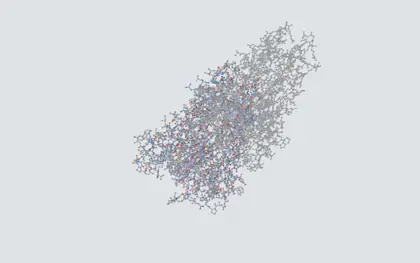
Description
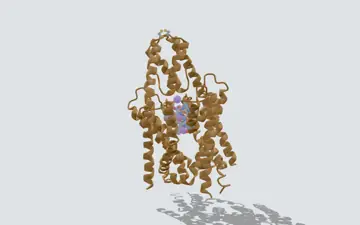
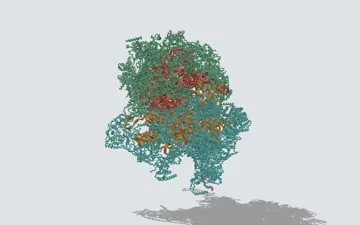
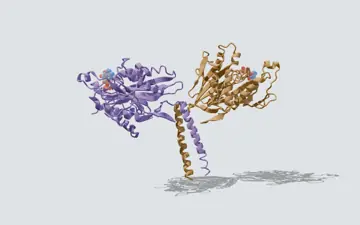
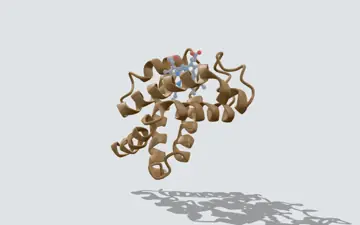
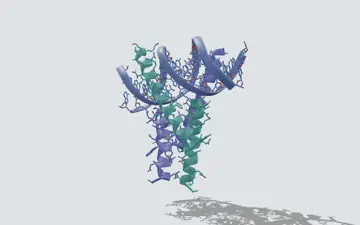
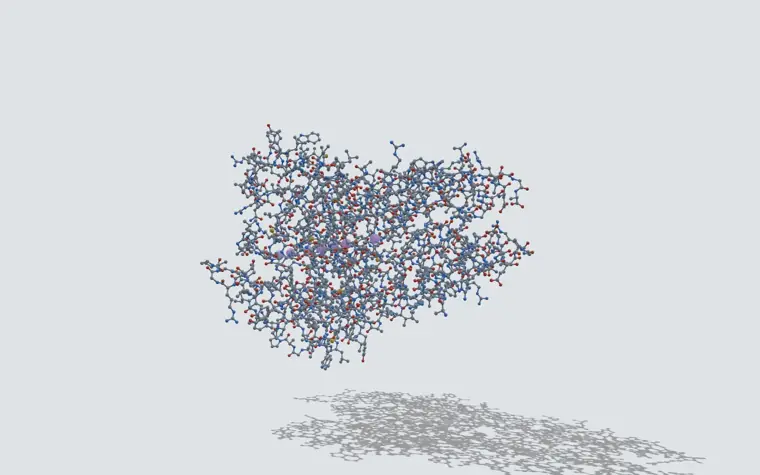
KcsA potassium channel (also called bacterial K⁺ channel, Streptomyces lividans): The bacterial potassium channel whose crystal structure, solved in 1998, first showed how a channel can let K⁺ through a hundred million times a second while turning Na⁺ away. Size: ≈ 5 nm across, 4 × 160 amino acids. Mass: ≈ 70 kDa (tetramer). 3D model: every atom of a real structure.
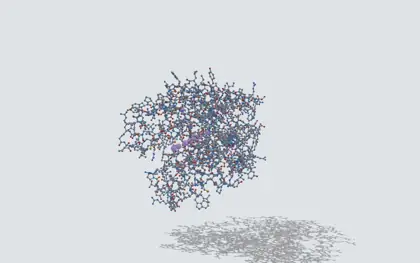
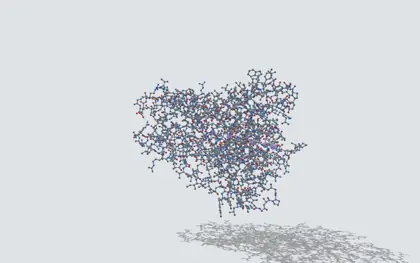
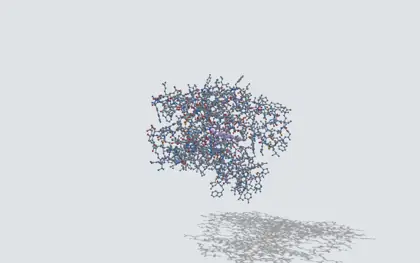
Every heavy atom of the 2.0 Å crystal structure; the seven purple balls on the axis are the K⁺ positions the crystal shows.
Where the triangles are
Materials
- C carbonMeshStandard · metal 0 · rough 0.4
- N nitrogenMeshStandard · metal 0 · rough 0.4
- O oxygenMeshStandard · metal 0 · rough 0.4
- S sulfurMeshStandard · metal 0 · rough 0.4
- K⁺ ions (7)MeshStandard · metal 0 · rough 0.3
Motion
No animation is defined in this model's code: its builder returns a still model, with no clips, no update function and no time-driven material. In the app the part also appears in the lab station `brain/channel`, a live simulation; a station is a scene of its own, not part of this model, and is not captured here.
Specification
| Category | Science and biology / Proteins and subunits |
|---|---|
| Kind | Proteins |
| Collection | Proteins |
| Repository | LAB |
| Version kept | Cell to Quantum, current source, 2026-11-11 |
| Confidence | high |
| Runtime | threejs |
| Bounding box | 77.9 × 70.3 × 90.4 scene units |
| Draw calls | 9 |
| Code | cell-journey/src/js/61-library-models.js + 2 files |
| Built and measured | 2026-11-24, 0.1 s build, three.js r160 |