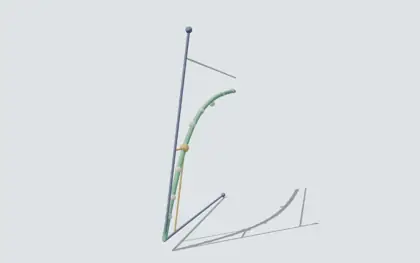
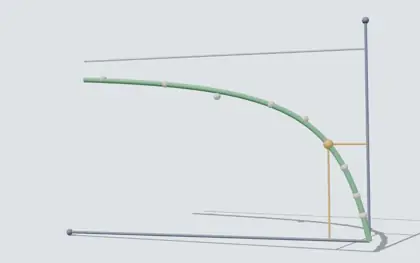
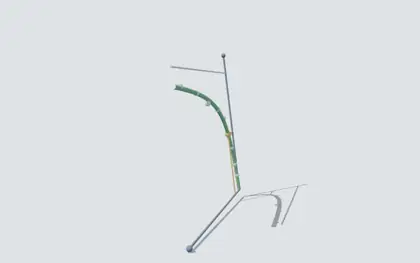

Description
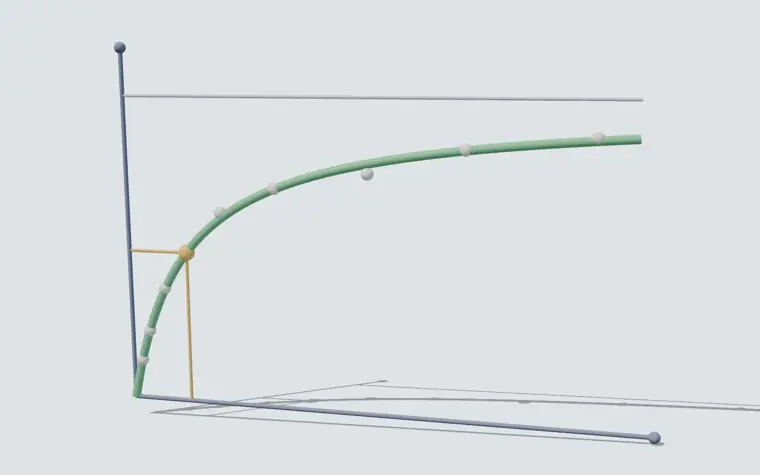
Michaelis–Menten kinetics (also called Michaelis–Menten; the Michaelis–Menten equation; the Michaelis–Menten curve; saturation kinetics): The rule for how an enzyme’s rate depends on the concentration of its substrate: v = Vmax·[S] / (Km + [S]). The rate rises with substrate and then levels off, because an enzyme that is already busy cannot go faster.
Size: a law for how fast an enzyme works. 3D model: custom builder "enz-mm". Shown: the curve, drawn from the equation.
Where the triangles are
Materials
- Measured points scatter about the curveMeshStandard · metal 0 · rough 0.4
- The rate: v = Vmax·[S] / (Km + [S])MeshStandard · metal 0 · rough 0.4
- Axes: substrate concentration (across), rate (up)MeshStandard · metal 0 · rough 0.6
- Km: the concentration that gives half the top speedMeshStandard · metal 0 · rough 0.4
- Vmax: the top speed, when every enzyme is busyMeshStandard · metal 0 · rough 0.4
Motion
No animation is defined in this model's code: its builder returns a still model, with no clips, no update function and no time-driven material. In the app the part also appears in the lab station `cell/enzyme`, a live simulation; a station is a scene of its own, not part of this model, and is not captured here.
Specification
| Category | Science and biology / Biological processes |
|---|---|
| Kind | Processes |
| Collection | Processes |
| Repository | LAB |
| Version kept | Cell to Quantum, current source, 2026-11-11 |
| Confidence | high |
| Runtime | threejs |
| Bounding box | 8.41 × 6.13 × 2.74 scene units |
| Draw calls | 7 |
| Code | cell-journey/src/js/76-cell-02-enzyme.js + 3 files |
| Built and measured | 2026-11-24, 0.0 s build, three.js r160 |