Description
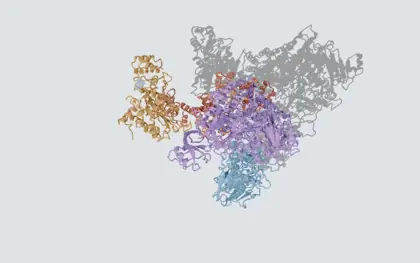
Primase (Pol α–primase) (also called the primosome; DnaG in bacteria): The enzyme that starts new strands. No DNA polymerase can begin from nothing, so primase first lays a short RNA primer of about ten letters. In our cells it works as one machine with DNA polymerase α, which adds about twenty letters of DNA and hands over.
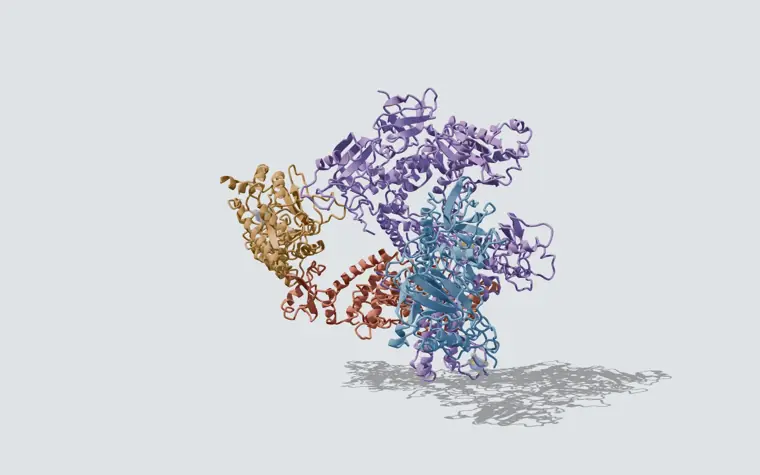
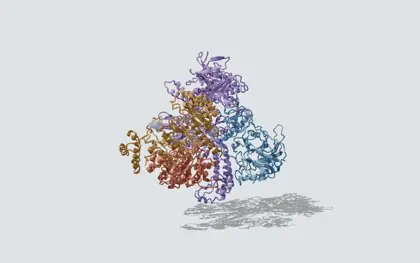
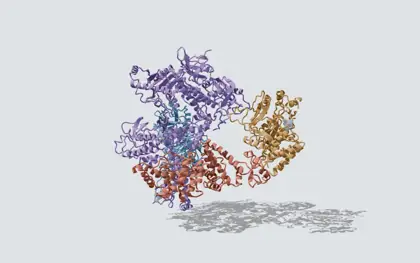
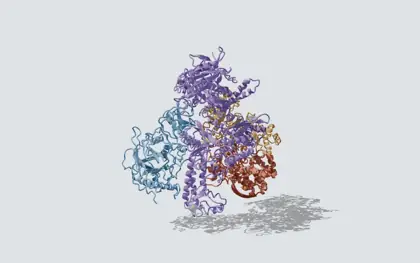
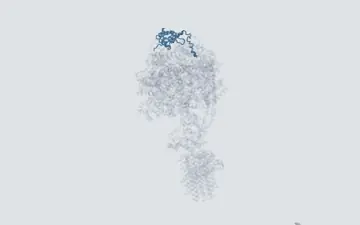
Size: ≈ 14 × 12 × 10 nm. Mass: ≈ 340 kDa (four subunits). 3D model: backbone trace from the C-alpha atoms of a PDB entry, selected chains in colour. Shown: the human primosome at rest, PDB 5EXR (2016). All four subunits of the human primosome in the compact resting form, without DNA: the two primase subunits and the two Pol α subunits.
At work the lobes swing apart to pass the primer from primase to Pol α. The backbones are drawn from their C-alpha atoms.
Where the triangles are
Materials
- Pol α catalytic subunit (POLA1)MeshStandard · metal 0 · rough 0.42
- Pol α, subunit B (POLA2)MeshStandard · metal 0 · rough 0.42
- primase, large subunit (PRIM2)MeshStandard · metal 0 · rough 0.42
- primase, small subunit (PRIM1)MeshStandard · metal 0 · rough 0.42
- side chains holding the zincMeshStandard · metal 0 · rough 0.3
- side chains holding the zincMeshStandard · metal 0 · rough 0.3
- iron–sulphur cluster [4Fe–4S]MeshStandard · metal 0 · rough 0.3
- iron–sulphur cluster [4Fe–4S]MeshStandard · metal 0 · rough 0.3
- cysteines holding the iron–sulphur clustersMeshStandard · metal 0 · rough 0.3
- Zn²⁺MeshStandard · metal 0 · rough 0.3
And 1 more.
Motion
No animation is defined in this model's code: its builder returns a still model, with no clips, no update function and no time-driven material. In the app the part also appears in the lab station `cell/replication`, a live simulation; a station is a scene of its own, not part of this model, and is not captured here.
Specification
| Category | Science and biology / Molecular machines |
|---|---|
| Kind | Machines |
| Collection | Machines |
| Repository | LAB |
| Version kept | Cell to Quantum, current source, 2026-11-11 |
| Confidence | high |
| Runtime | threejs |
| Bounding box | 166.4 × 137.7 × 155.2 scene units |
| Draw calls | 17 |
| Code | cell-journey/src/js/61-library-models.js + 2 files |
| Built and measured | 2026-11-24, 0.4 s build, three.js r160 |
Effects
More molecular machines See all 54
 Proton half-channelsMachines
 Replication forkMachines
 Replicative helicase (CMG)Machines
 RGS9Machines
 Rhodopsin–transducin complexMachines
 RNA polymerase IIMachines
 Sec61 transloconMachines
 Signal peptidase complexMachines
 Signal recognition particle (SRP)Machines
 SNARE complexMachines
 SpliceosomeMachines
 Subunit OSCPMachines