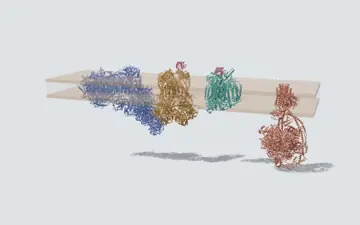
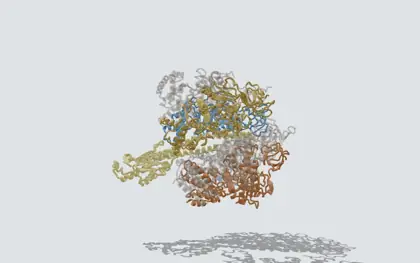
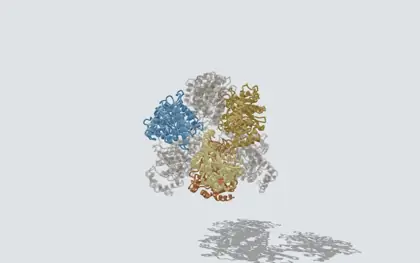
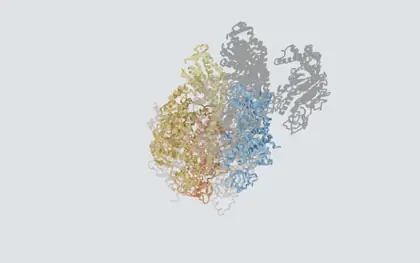
Description
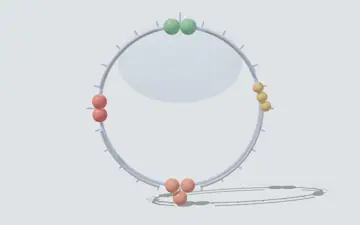
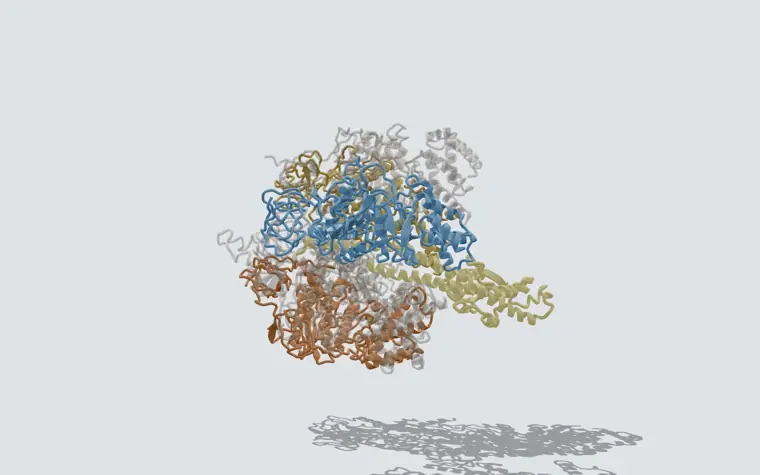
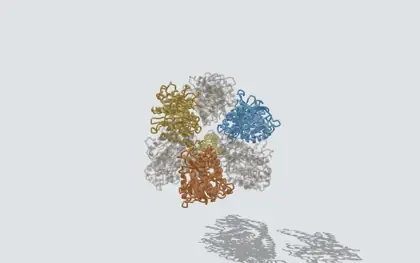
Binding-change mechanism (also called Boyer’s alternating sites: open, loose, tight): How the head of ATP synthase makes ATP. Its three catalytic sites take turns in three states: open, loose and tight. The turning shaft changes how firmly each site grips what it holds, and the energy goes into letting ATP go, not into forming it.
Size: three sites 120° apart in a head ≈ 10 nm wide. 3D model: custom builder "atp-bcm".
Where the triangles are
Materials
- α subunits (faded): no catalysisMeshStandard · metal 0 · rough 0.5
- loose: ADP and phosphate (βDP)MeshStandard · metal 0 · rough 0.42
- open: empty (βE)MeshStandard · metal 0 · rough 0.42
- tight: ATP (βTP)MeshStandard · metal 0 · rough 0.42
- γ: the lopsided shaftMeshStandard · metal 0 · rough 0.4
- ATP, ADP and phosphate in the sitesMeshStandard · metal 0 · rough 0.35
- ATP, ADP and phosphate in the sitesMeshStandard · metal 0 · rough 0.35
- ATP, ADP and phosphate in the sitesMeshStandard · metal 0 · rough 0.35
Motion
No animation is defined in this model's code: its builder returns a still model, with no clips, no update function and no time-driven material. In the app the part also appears in the lab station `cell/atpsynthase`, a live simulation; a station is a scene of its own, not part of this model, and is not captured here.
Specification
| Category | Science and biology / Biological processes |
|---|---|
| Kind | Processes |
| Collection | Processes |
| Repository | LAB |
| Version kept | Cell to Quantum, current source, 2026-11-11 |
| Confidence | high |
| Runtime | threejs |
| Bounding box | 11.8 × 15.3 × 15.7 scene units |
| Draw calls | 10 |
| Code | cell-journey/src/js/76-cell-04-atpsynthase.js + 3 files |
| Built and measured | 2026-11-24, 0.3 s build, three.js r160 |