Description
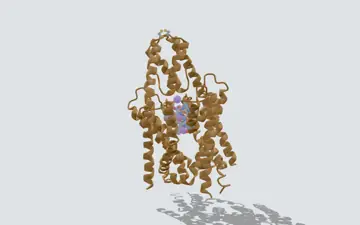
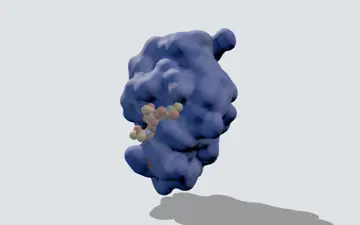
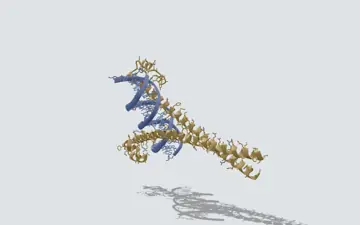
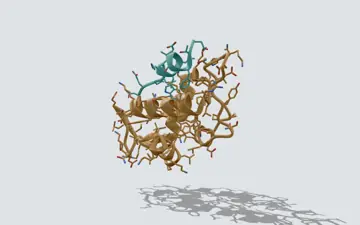
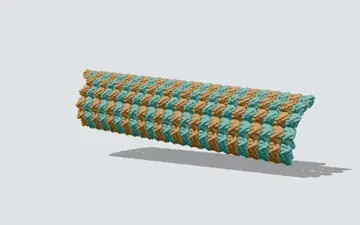
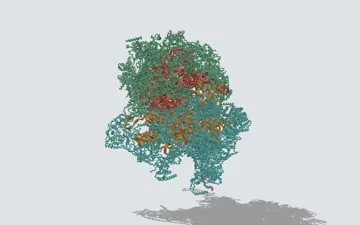
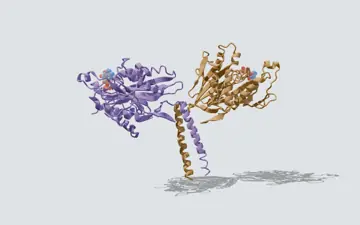
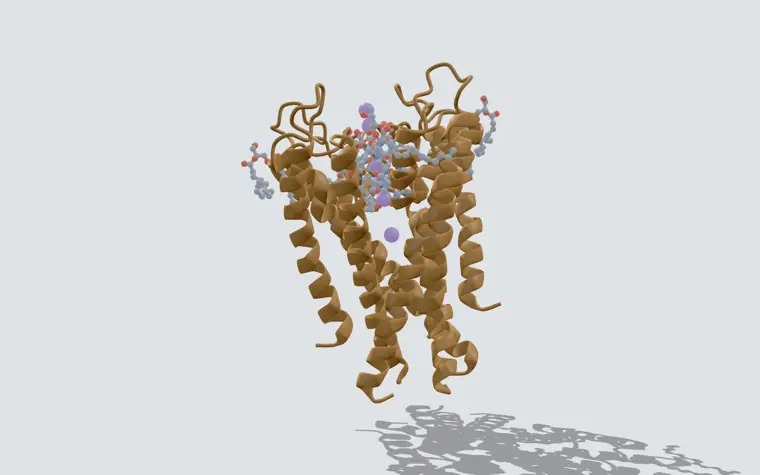
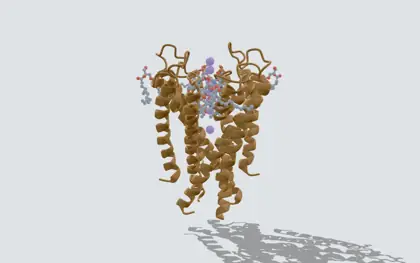
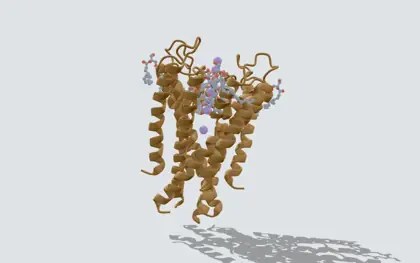
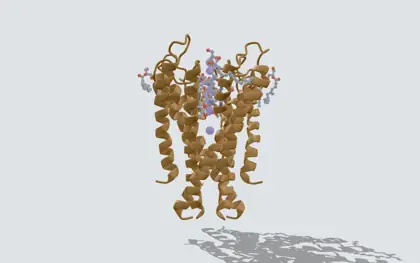
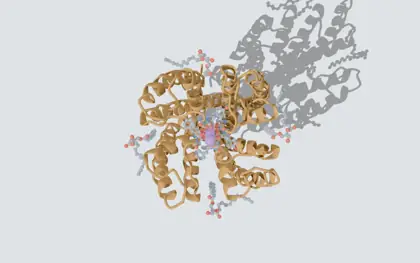
A protein pore through the plasma membrane that opens to let a particular ion across. In the journey it is drawn as a generic tetramer, enlarged so the camera can pass through. Size: ≈ 8 nm across. Mass: ≈ 150–400 kDa. 3D model: custom builder "real-trace". Shown: KcsA, a small bacterial potassium channel (PDB 1K4C): four subunits, eight helices.
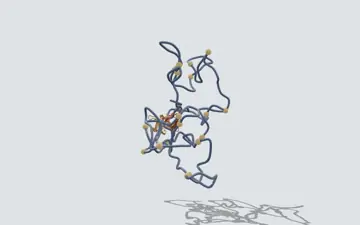
A real channel stands for the family: KcsA, a potassium channel from a soil bacterium and the first ion channel whose structure was solved (1998). Its four identical subunits surround one pore; the channels of human cells are larger (24 helices in a voltage-gated channel) but keep this pore at their centre. The backbone is drawn from one point per residue, its C-alpha atom.
Where the triangles are
Materials
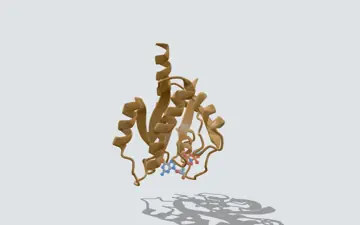
- diacylglycerolMeshStandard · metal 0 · rough 0.3
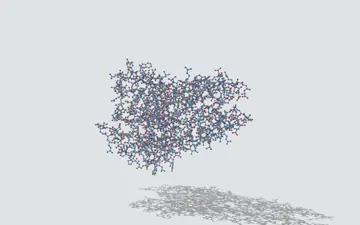
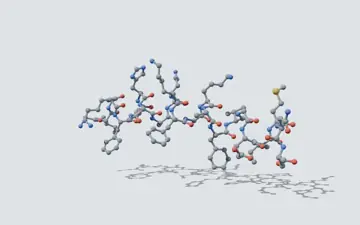
- selectivity filter, every atom (TVGYG)MeshStandard · metal 0 · rough 0.3
- KcsA subunitMeshStandard · metal 0 · rough 0.42
- selectivity filter, every atom (TVGYG)MeshStandard · metal 0 · rough 0.3
- selectivity filter, every atom (TVGYG)MeshStandard · metal 0 · rough 0.3
- diacylglycerolMeshStandard · metal 0 · rough 0.3
- K⁺ ions in the poreMeshStandard · metal 0 · rough 0.3
Specification
| Category | Science and biology / Proteins and subunits |
|---|---|
| Kind | Proteins |
| Collection | Proteins |
| Repository | LAB |
| Version kept | Cell to Quantum, current source, 2026-11-11 |
| Confidence | high |
| Runtime | threejs |
| Bounding box | 61.9 × 69.4 × 65.0 scene units |
| Draw calls | 15 |
| Code | cell-journey/src/js/61x-models-real.js + 2 files |
| Built and measured | 2026-11-24, 0.2 s build, three.js r160 |