Description
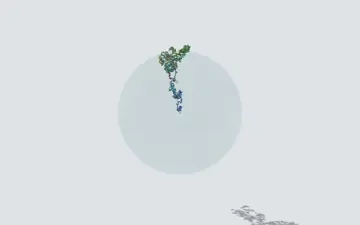
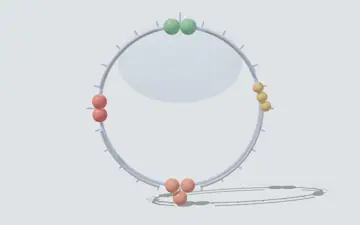
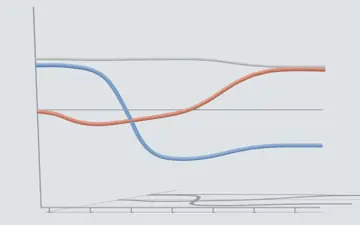
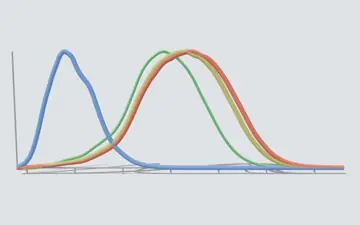
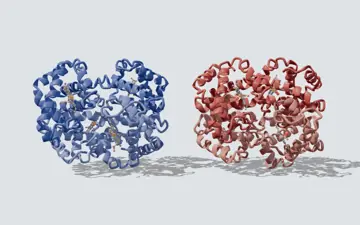
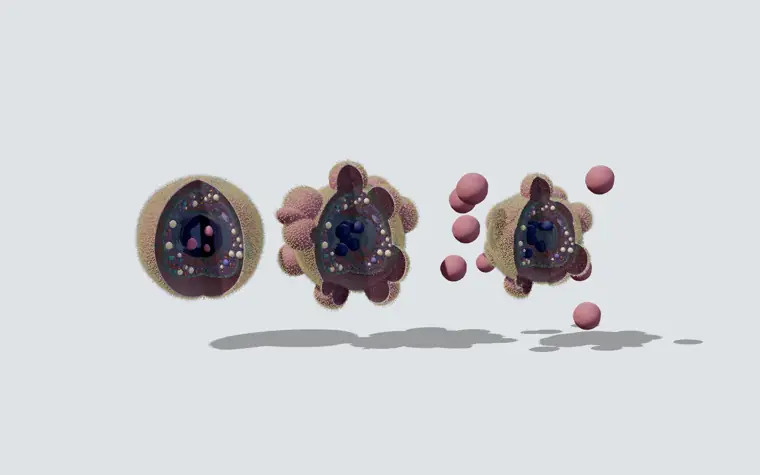
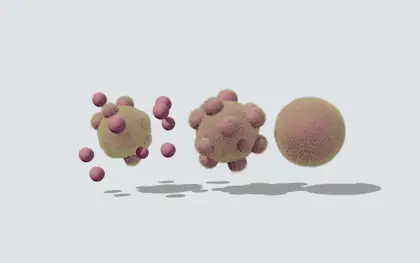
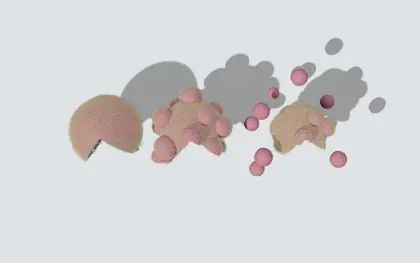
Apoptosis (also called programmed cell death, cell suicide): The orderly way in which a cell kills itself when it is damaged, unwanted or told to die. Enzymes called caspases take it apart from within: the cell shrinks and rounds up, its chromatin packs tight, the nucleus breaks into pieces, the surface blebs, and the cell divides into sealed parcels that its neighbours eat.
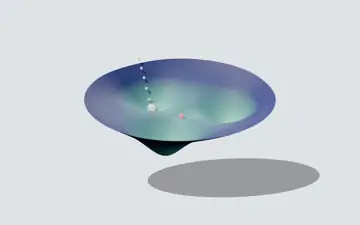
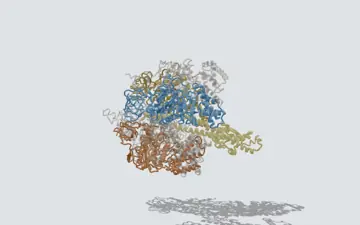
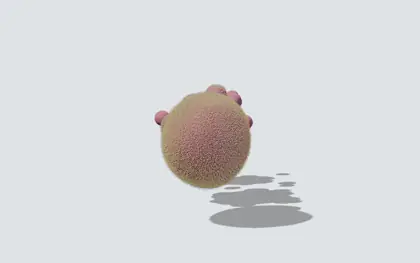
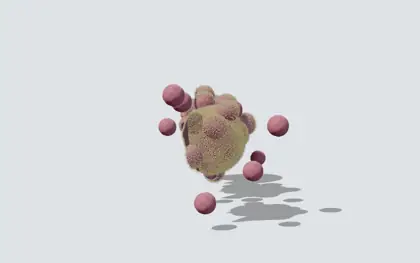
Nothing spills, so nothing is inflamed. Cancer cells survive partly by switching it off. Size: a whole cell, ≈ 10–20 µm, ending as sealed bodies of ≈ 1–5 µm; from under an hour to a few hours. 3D model: custom builder "cancer-apoptosis". Shown: three stages of one cell, cut open; shapes built by rule.
Where the triangles are
Materials
- HER2, a growth-factor receptor: about 1–2 million on a HER2-positive breast cancer cell against about 20,000 on a normal cell (11,403 beads, each standing for about 100, enlarged about 15 times)MeshStandard · metal 0 · rough 0.45
- HER2, a growth-factor receptor: about 1–2 million on a HER2-positive breast cancer cell against about 20,000 on a normal cell (11,403 beads, each standing for about 100, enlarged about 15 times)MeshStandard · metal 0 · rough 0.45
- HER2, a growth-factor receptor: about 1–2 million on a HER2-positive breast cancer cell against about 20,000 on a normal cell (11,403 beads, each standing for about 100, enlarged about 15 times)MeshStandard · metal 0 · rough 0.45
- free ribosomes and polysomes (strings of ribosomes on one messenger RNA) crowding the cytoplasm: a few million in the cell (52,002 dots, each standing for hundreds, enlarged two times)MeshStandard · metal 0 · rough 0.6
- free ribosomes and polysomes (strings of ribosomes on one messenger RNA) crowding the cytoplasm: a few million in the cell (52,002 dots, each standing for hundreds, enlarged two times)MeshStandard · metal 0 · rough 0.6
- free ribosomes and polysomes (strings of ribosomes on one messenger RNA) crowding the cytoplasm: a few million in the cell (52,002 dots, each standing for hundreds, enlarged two times)MeshStandard · metal 0 · rough 0.6
- mitochondria: in the internal pathway they release cytochrome c, the signal that sets off the caspases; like the other organelles they stay wholeMeshStandard · metal 0 · rough 0.5
- mitochondria: in the internal pathway they release cytochrome c, the signal that sets off the caspases; like the other organelles they stay wholeMeshStandard · metal 0 · rough 0.5
- mitochondria: in the internal pathway they release cytochrome c, the signal that sets off the caspases; like the other organelles they stay wholeMeshStandard · metal 0 · rough 0.5
- nuclear pores, each 120 nm across: about 3400 on a nucleus this size at 10 per µm² (2565 drawn)MeshStandard · metal 0 · rough 0.45
And 68 more.
Motion
No animation is defined in this model's code: its builder returns a still model, with no clips, no update function and no time-driven material. In the app the part also appears in the lab station `cell/cancer`, a live simulation; a station is a scene of its own, not part of this model, and is not captured here.
Specification
| Category | Science and biology / Biological processes |
|---|---|
| Kind | Processes |
| Collection | Processes |
| Repository | LAB |
| Version kept | Cell to Quantum, current source, 2026-11-17 |
| Confidence | high |
| Runtime | threejs |
| Bounding box | 241.1 × 91.6 × 115.6 scene units |
| Draw calls | 82 |
| Rig | 0 bones, 0 skinned meshes, 45 morph targets |
| Code | cell-journey/src/js/61x-models-cancer.js + 3 files |
| Built and measured | 2026-11-24, 3.3 s build, three.js r160 |