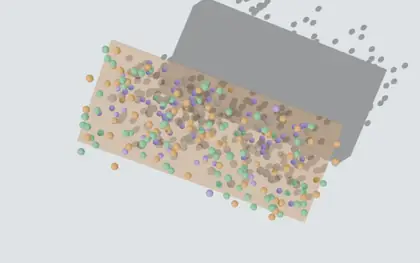
Description
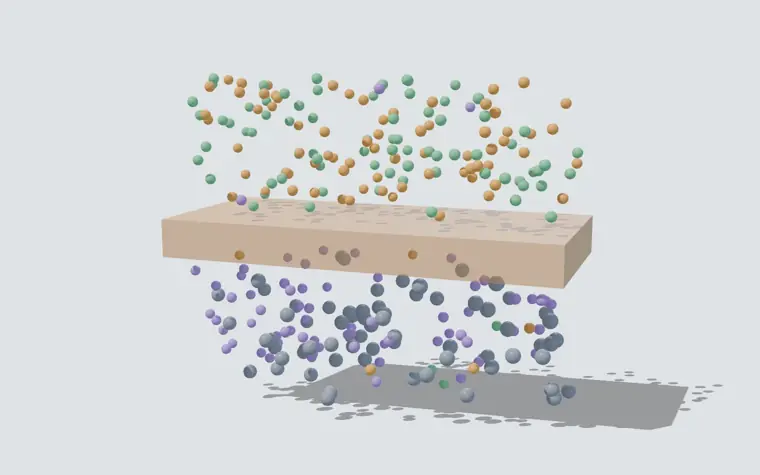
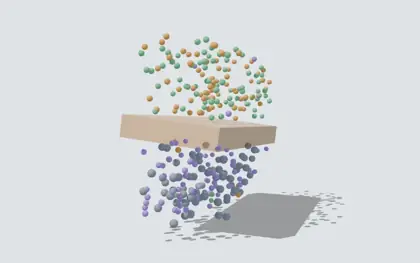
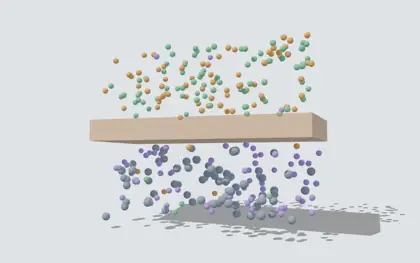
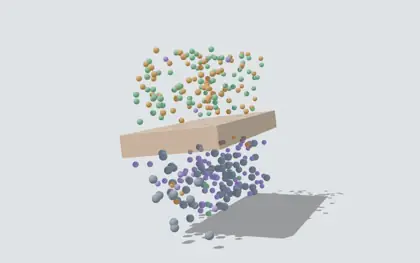
Ion gradients (also called electrochemical gradient, ion gradient, Nernst potential, equilibrium potential, concentration gradient): The difference in an ion’s concentration across a membrane, taken together with the voltage. Together they decide which way the ion will move and how much energy it gives up or needs. For each ion there is one voltage, its Nernst potential, at which the two pulls cancel.
Size: tenfold and more across a membrane ≈ 5 nm thick. 3D model: custom builder "mem-gradient".
Where the triangles are
Materials
- Cl⁻: 150 mM outside, 7.5 mM insideMeshStandard · metal 0 · rough 0.35
- Na⁺: 145 mM outside, 11 mM insideMeshStandard · metal 0 · rough 0.35
- K⁺: 5 mM outside, 139 mM insideMeshStandard · metal 0 · rough 0.35
- large anions that cannot cross: about 143 mM insideMeshStandard · metal 0 · rough 0.35
- membrane (top is outside)MeshStandard · metal 0 · rough 0.6
Motion
No animation is defined in this model's code: its builder returns a still model, with no clips, no update function and no time-driven material. In the app the part also appears in the lab station `cell/membrane`, a live simulation; a station is a scene of its own, not part of this model, and is not captured here.
Specification
| Category | Science and biology / Biological processes |
|---|---|
| Kind | Processes |
| Collection | Processes |
| Repository | LAB |
| Version kept | Cell to Quantum, current source, 2026-11-11 |
| Confidence | high |
| Runtime | threejs |
| Bounding box | 50.1 × 41.4 × 37.3 scene units |
| Draw calls | 5 |
| Code | cell-journey/src/js/76-cell-08-membrane.js + 3 files |
| Built and measured | 2026-11-24, three.js r160 |
Effects
More biological processes See all 80
 Light adaptationProcesses
 Long-term potentiation (LTP)Processes
 Macromolecular crowdingProcesses
 MetamerProcesses
 Michaelis–Menten kineticsProcesses
 Mismatch repairProcesses
 MitosisProcesses
 Motor-driven transportProcesses
 Neural networkProcesses
 Optical trapProcesses
 Orientation columnProcesses
 OsmosisProcesses