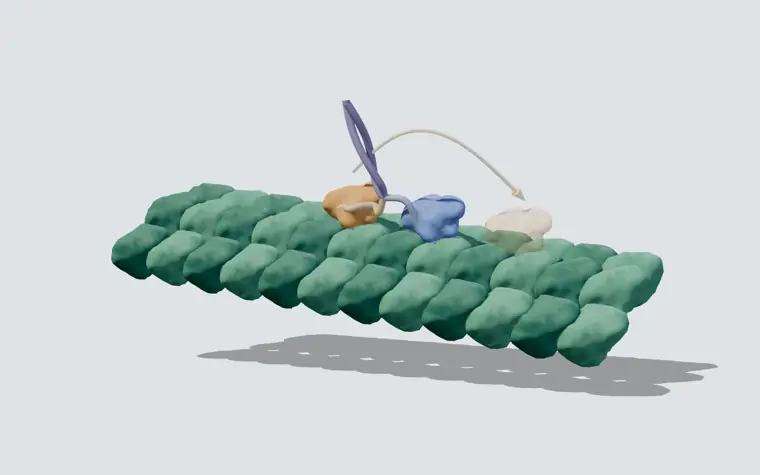
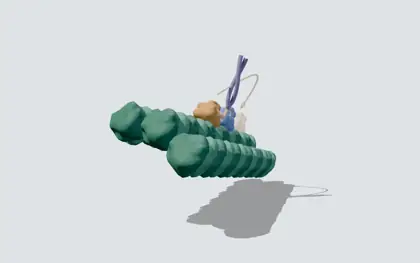
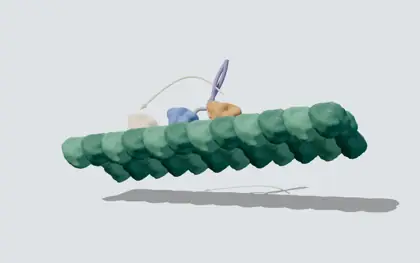
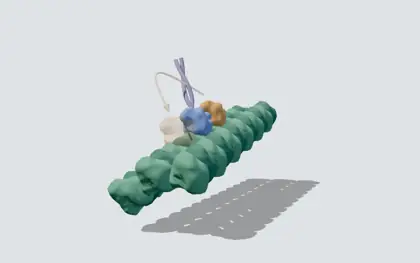
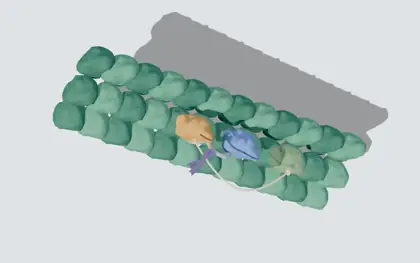
Description
Hand-over-hand walking (also called hand over hand, alternating-head stepping): How a two-headed motor walks. The rear head lets go, swings past the head that is holding on and lands in front of it, so the two heads take turns to lead, like feet. One head is always attached, which is why the motor can take a hundred steps without falling off.
Size: each head moves ≈ 16 nm per stride; the cargo moves 8 nm per step. 3D model: custom builder "kin-hoh".
Where the triangles are
Materials
- β-tubulinMeshStandard · metal 0 · rough 0.6
- α-tubulinMeshStandard · metal 0 · rough 0.6
- neck linkers and the start of the stalk (schematic)MeshStandard · metal 0 · rough 0.5
- where the rear head lands next: 16 nm on from where it standsMeshStandard · metal 0 · rough 0.4
- neck linkers and the start of the stalk (schematic)MeshStandard · metal 0 · rough 0.4
- neck linkers and the start of the stalk (schematic)MeshStandard · metal 0 · rough 0.4
- front head: empty, gripping the track (PDB 3J8X)MeshStandard · metal 0 · rough 0.5
- where the rear head lands next: 16 nm on from where it standsMeshStandard · metal 0 · rough 0.5
- rear head: ATP bound, neck linker docked forward (PDB 3J8Y)MeshStandard · metal 0 · rough 0.5
Motion
No animation is defined in this model's code: its builder returns a still model, with no clips, no update function and no time-driven material. In the app the part also appears in the lab station `cell/kinesin`, a live simulation; a station is a scene of its own, not part of this model, and is not captured here.
Specification
| Category | Science and biology / Biological processes |
|---|---|
| Kind | Processes |
| Collection | Processes |
| Repository | LAB |
| Version kept | Cell to Quantum, current source, 2026-11-11 |
| Confidence | high |
| Runtime | threejs |
| Bounding box | 55.5 × 26.4 × 34.8 scene units |
| Draw calls | 11 |
| Code | cell-journey/src/js/76-cell-05-kinesin.js + 3 files |
| Built and measured | 2026-11-24, 0.2 s build, three.js r160 |
Effects
More biological processes See all 80
 Hebb’s ruleProcesses
 Hopfield networkProcesses
 Ion gradientsProcesses
 Light adaptationProcesses
 Long-term potentiation (LTP)Processes
 Macromolecular crowdingProcesses
 MetamerProcesses
 Michaelis–Menten kineticsProcesses
 Mismatch repairProcesses
 MitosisProcesses
 Motor-driven transportProcesses
 Neural networkProcesses