Description
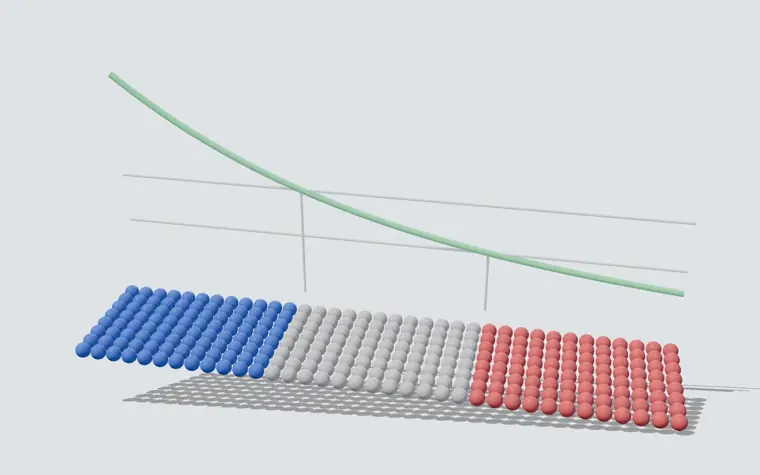
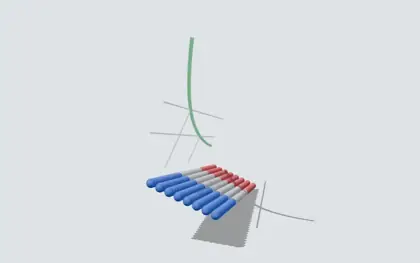
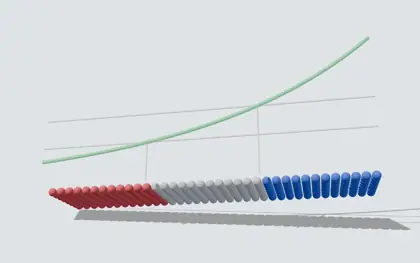
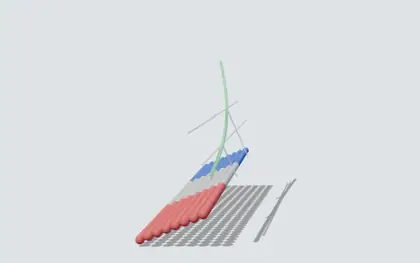
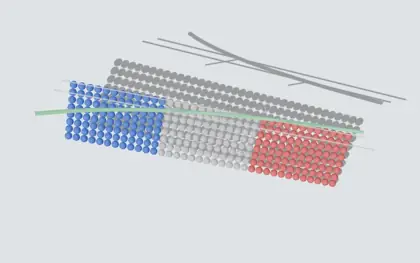
French flag model (also called positional information, threshold reading of a gradient): Lewis Wolpert’s answer, in 1969, to how identical cells come to form a pattern: a smooth gradient gives each cell its position, and each cell then chooses a fate by comparing the level it reads with thresholds. Two thresholds make three bands, like a flag.
Size: an idea about fields of cells up to about 1 mm across. 3D model: custom builder "morph-flag".
Where the triangles are
Materials
- above both thresholds: the first fateMeshStandard · metal 0 · rough 0.5
- between them: the second fateMeshStandard · metal 0 · rough 0.5
- below both: the third fateMeshStandard · metal 0 · rough 0.5
- the morphogen’s concentrationMeshStandard · metal 0 · rough 0.4
- two thresholds, and where the curve crosses themMeshStandard · metal 0 · rough 0.5
Motion
No animation is defined in this model's code: its builder returns a still model, with no clips, no update function and no time-driven material. In the app the part also appears in the lab station `gene/morphogen`, a live simulation; a station is a scene of its own, not part of this model, and is not captured here.
Specification
| Category | Science and biology / Biological processes |
|---|---|
| Kind | Processes |
| Collection | Processes |
| Repository | LAB |
| Version kept | Cell to Quantum, current source, 2026-11-11 |
| Confidence | high |
| Runtime | threejs |
| Bounding box | 74.4 × 41.2 × 30.3 scene units |
| Draw calls | 5 |
| Code | cell-journey/src/js/74-gene-17-morphogen.js + 3 files |
| Built and measured | 2026-11-24, 0.0 s build, three.js r160 |
Effects
More biological processes See all 80
 Glucose homeostasisProcesses
 GlycolysisProcesses
 Hand-over-hand walkingProcesses
 Hebb’s ruleProcesses
 Hopfield networkProcesses
 Ion gradientsProcesses
 Light adaptationProcesses
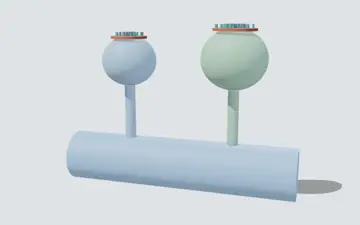 Long-term potentiation (LTP)Processes
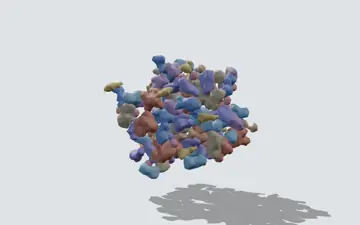 Macromolecular crowdingProcesses
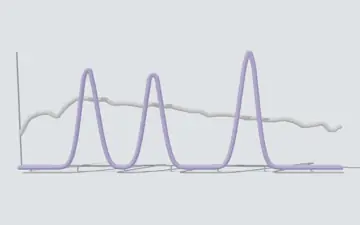 MetamerProcesses
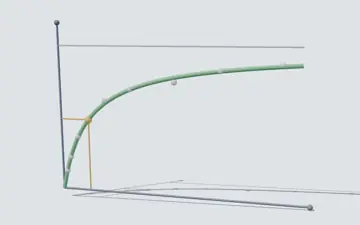 Michaelis–Menten kineticsProcesses
 Mismatch repairProcesses